Lessons from an “Exemption Exam” CTF: Combining Ethical Hacking with Real-World Challenges
Lessons learned from conducting an ethical hacking "exemption exam" CTF for university students at Sapienza University of Rome, exploring LLM usage in CTFs, anti-cheating, and hands-on offensive security.
As part of the ethical hacking course I am teaching at La Sapienza University of Rome, I recently conducted an “exemption exam” in the form of a Capture The Flag (CTF) competition. This exercise was designed to simulate real-world hacking challenges and test students’ practical skills in a controlled environment.
The CTF required students to capture three flags, each corresponding to a different user, to prove their access level. Students had 2 hours and 45 minutes to do so. The first three students to capture the root flag received maximum marks (30/30 cum laude), while others were graded based on their progress.
Themed Environment and Technical Challenges
Inspired by the “Back to the Future” movie (which I watched recently with my kids), the CTF machine was named after the DeLorean time machine.
The web application featured a classical 2-tiered architecture, running on a home Kubernetes cluster. It was built using Python (Flask) with a PostgreSQL database.
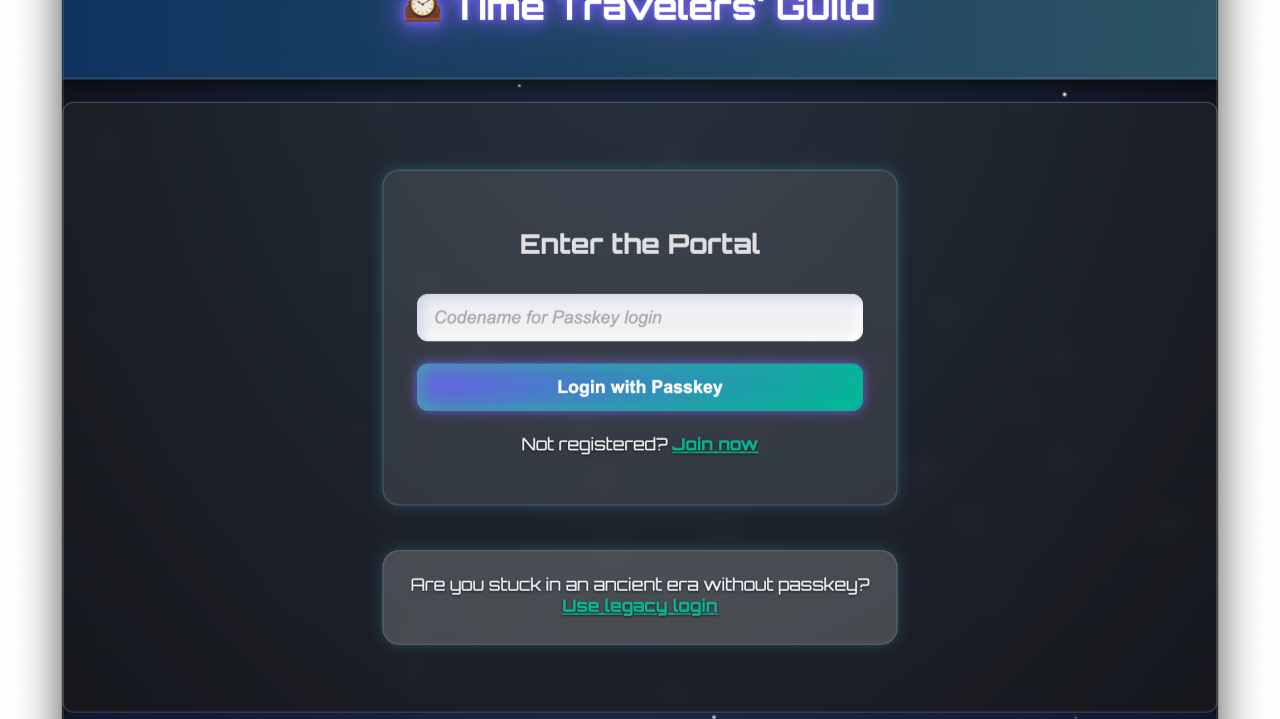
To give a “futuristic” touch (actually, more a contemporary one 😀), I implemented a password-less registration system using WebAuthn / Passkeys. Students could register using either passkeys or usernames and passwords. After that, they could access the DeLorean dashboard.
Intended Exploitation Path
- Initial Access: The dashboard accepted temporal coordinates to simulate a “temporal jump”. By design, it was vulnerable to command injection through a poorly sanitized parameter, allowing students to obtain a reverse shell.
- Privilege Escalation (User): Once they had a reverse shell, students discovered a setuid binary owned by a user
ebrown, which was vulnerable to a path/environment manipulation vulnerability. - Root Escalation: By exploiting this, they could impersonate
ebrown(with its effective UID) and access a memory coredump that revealed the final credential material needed to escalate toroot.
Key Lessons Learned
As one of my students commented at the end of the CTF: I allowed using LLMs because I knew they would not be enough.
I saw a diverse range of LLMs and versions being used: DeepSeek, generic ChatGPT, custom GPTs focused on ethical hacking, and Claude.
The results spoke for themselves:
- 37 students registered
- 30 captured the first flag
- 22 captured the second flag
- 15 captured the third (
root) flag
The first student, who captured all the flags, did so in about 1 hour.
An unplanned but interesting side effect (which I could have anticipated in hindsight) was that, towards the end of the exam, many students relied heavily on LLMs to debug their exploits. This often led to a “prompt loop” where students spent more time refining prompts than analyzing the binary or network traffic.
Again, one of the most significant insights for the students was that AI and generic online instructions can provide hints, but without foundational knowledge and hands-on experience, they cannot solve non-trivial security challenges.
Conclusion
Overall, the CTF was a resounding success. It tested students’ technical abilities and underscored the importance of foundational knowledge in binary exploitation, web security, and Linux internals.
While this exercise was meant to simulate real-life engagements, we are still only scratching the surface of ethical hacking. Since this was an ethical hacking course, we also had an anti-cheating system in place to ensure the integrity of the exam (monitoring network traffic, unique per-student flag generation, and correlation of submission timestamps).